How to Price Add and Deduct Alternates on a Construction Bid
To price add and deduct alternates on a construction bid, establish the base scope first. For each alternate, identify exactly what changes, then calculate the amount to add to or subtract from the base under the bid instructions. Label each amount and explain whether two alternatives can be selected together. That lets a reviewer compare options without trying to reconstruct the base bid from a set of separate prices.
Confirm what belongs in the base bid
Read the bid form and current drawings before pricing any option. Identify the baseline materials, quantities, labor, schedule, and access assumptions. If a note on the drawing mentions an alternate, verify whether that work is part of the base or is to be added separately. Give the base estimate a stable version. As the scope changes, review the construction addendum tracking guide for a way to keep the decision and the revised quantity attached to the same estimate.
Define the option as a scope difference
A material alternate may replace a base material rather than add a second one. A deduct alternate may remove a portion of the work while leaving delivery or setup costs in place. List the lines that are removed or changed and write what remains in the bid. If the alternate affects labor, accessory materials, or sequence, account for those separately in your working numbers. Small descriptions can hide a larger change in what the crew will do.
Show the net amount the bid form asks for
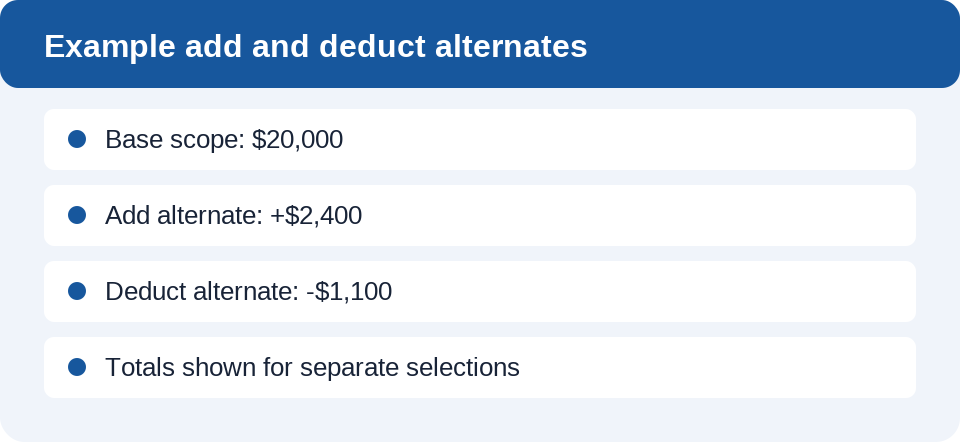
Suppose the base finishes estimate is $20,000. An upgraded material option costs $2,400 more than the base work it replaces, with the same assumed installation conditions. Written as an add alternate, it brings that example to $22,400 if selected. A separate option deletes work that would save $1,100 under the agreed scope. As a deduct alternate it brings the example to $18,900 if selected alone. Keep the full working details, even if the submitted form only asks for the changes.
Check overlaps before showing a combined total
Two alternatives can affect the same part of the job. An upgrade to a finish and a deletion of the room receiving that finish cannot always be added and subtracted independently. Before showing a total with multiple options, check where their quantities, labor, or site costs overlap. Ask for clarification when the bid documents don't make the selection rules clear. Use the same labels and numbering the recipient expects so a decision can be traced back to the right scope.
Review what remains when work is removed
Give deduct alternates an extra check for tasks that stay in the job. You might remove an item without eliminating the crew's trip, the equipment setup, or protection needed for adjacent work. Only deduct the cost and work actually affected by the option under the project scope. The small job mobilization guide explains how to identify planned trips and setup separately so those costs are easy to review.
Allowances warrant a separate treatment if the bid uses them. An allowance budgets an item still subject to a selection or confirmation. An alternate defines a different set of work the buyer may accept. See the bid allowance guide for a comparison. Follow the bid instructions and record what will be needed to issue the final scope after a selection.
Verify both estimate versions before sending
If the customer is choosing between suppliers, set a date to verify that the alternate is still available before award. Check whether the alternate has a different lead time or changes another trade's work. Explain those conditions next to the dollar amount so the person choosing the option can weigh both scope and timing.
Ask a reviewer to pick one option and explain what changes both in the number and in the work. Verify the arithmetic and make sure the description can stand on its own if it is forwarded. Note any vendor confirmation or drawing detail still needed. Keep a copy of the version you submit so the office can reproduce the figures later.
Use the Construction Cost Estimator overview to see where to organize the base estimate, and open the takeoff workspace when measurements change. Start with a single alternate on a sample bid. Confirm the amount, the changed scope, and the total you would show if the customer accepts it.