How to Price Mobilization on a Small Construction Bid
To price mobilization on a small construction bid, identify what it takes to get the crew, tools, and equipment to the site and ready to work, then count how often those actions will happen. Put the assumptions in the estimate. A day of on-site work can still require loading, travel, site setup, and a return trip. Those costs don't all shrink just because the measured quantity is small.
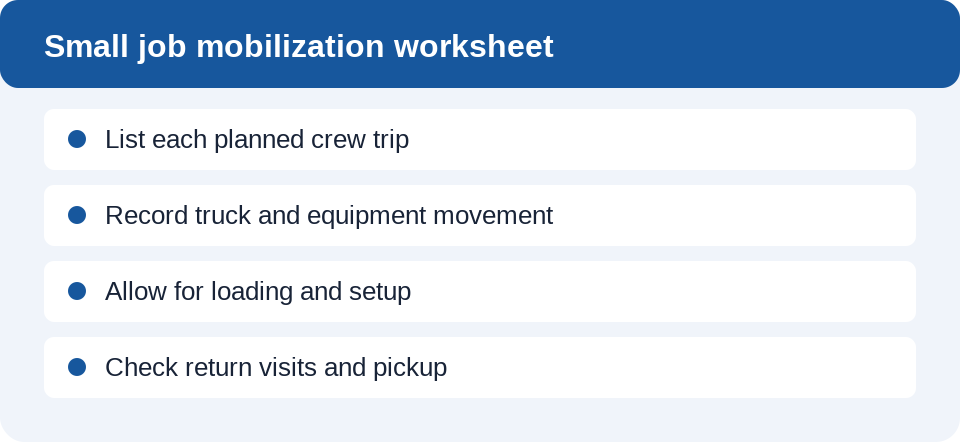
List the trips the work actually requires
Sketch a simple timeline for the job. A crew might make one trip to prepare the site and a second to complete or finish the work. Equipment may need its own delivery or pickup. Count trips by purpose, then confirm which people and vehicles are needed for each one. This prevents a trip for a rental item from disappearing into a general labor estimate. It also helps you find a trip you can combine if the schedule allows it.
Write down what happens before work starts
Include the work to load tools, protect occupied areas if the scope requires it, set up the equipment, and bring the site into the condition needed for the crew to begin. Separate job-specific tasks from ordinary costs already in your rates. If your labor rate already accounts for shop loading in a particular way, check the estimate before adding that same time as its own charge.
Build a cost breakdown you can review
One estimator might record crew travel as labor time, truck or trailer use as equipment time, third-party delivery as a vendor line, and setup as a job task. Another might group those costs into one estimate category. Either approach can work if you can trace each amount. Use your own actual rates and a schedule that fits the job. Record whether the estimate includes a final equipment pickup or ordinary cleanup.
For a simple scenario, assume two workers make two planned visits. If your estimate carries travel by worker, count the total time for both people on each visit, then add vehicle or delivery amounts according to your own cost structure. If you normally use a trip or service charge instead, show what that charge covers. The example isn't a standard rate. Its purpose is to check that travel time and setup appear somewhere in the estimate.
Test a second visit and an alternate schedule
If a milestone changes after you bid, work out which tasks are affected. Moving a delivery by two days may be easy. Splitting a single visit into two may add loading, setup and tear-down again. If the buyer asks for an alternate schedule, price the affected trips rather than just shifting dates on the bid. Record what access, work sequence, and site availability you assumed in the price.
Decide how the customer will see the price
The proposal can include one mobilization line, fold it into the job price with a clear scope note, or follow the bid form's required format. Use the format the customer needs and keep the calculation in your working estimate. Describe what the estimate covers in plain language. If the owner wants different timing or additional visits, you'll have a record to explain what would actually change.
Review similar provisional lines separately. An uncertain selection can be tracked as an allowance, while mobilization is usually based on the agreed plan and number of trips. The construction bid allowance guide shows why each provisional amount should explain its basis. If changes to drawings affect the planned sequence, the addendum tracking guide offers a method for keeping review notes beside the new estimate.
Try the breakdown on the next small job
Compare your estimate with a recent job that used similar equipment. Look at the dispatch or crew notes for the number of trips and which tasks took longer than expected. If the conditions differ, write down the difference before borrowing those hours. That comparison is especially useful when your proposed sequence depends on a rental or someone else's schedule.
Open the Construction Cost Estimator overview and use the job's existing labor and equipment categories to build a clear cost record. Start with a measured scope, add the planned visits, and compare the total with your actual crew schedule. Check the estimate once from the point of view of whoever will get the material and equipment to the site. Their trip list will often reveal which work still needs a line.