How to Estimate Floor Tile Waste and Round to Full Cartons
To estimate floor tile waste and round to full cartons, measure the net area, include an allowance based on the layout and cuts, then divide the adjusted area by verified coverage per carton and round up. Keep the measured area, allowance, and order quantity in separate rows. That way you can update a tile selection or pattern without pretending the room got bigger when the planned purchase changed.
How do you measure the area that will actually be tiled?
Break the plan into shapes that match the rooms and scope. Identify small recesses, transitions, and spaces such as closets separately if their inclusion is uncertain. Check dimensions and drawing revisions before multiplying anything. Label any area that has an open question. If you are using a PDF, the drawing scale checks in the drywall takeoff guide illustrate why a known dimension is more useful than assuming every view was printed at the same scale.
Keep area totals separate by tile and layout
Different rooms may use different products, sizes, or finishes. Even when the order is placed with one supplier, the carton coverage can differ. Record the tile type and planned pattern against each area. Confirm whether any offcuts can reasonably be reused across rooms using the same product. If a thin border or irregular shape changes the cut pattern, document that in your notes before setting the allowance.
What should the allowance cover?
Review the drawings, the installer’s planned layout, and the conditions you can verify. Consider the corners, transitions, directional patterns, and necessary cuts. Ask whether the customer wants any unopened material retained for future repair. Include that preference as its own quantity if it is part of the order. A retained carton and the material consumed in cuts serve different purposes. The allowance for one room or product may be a poor fit for the next job.
Work through an example without hiding the rounding
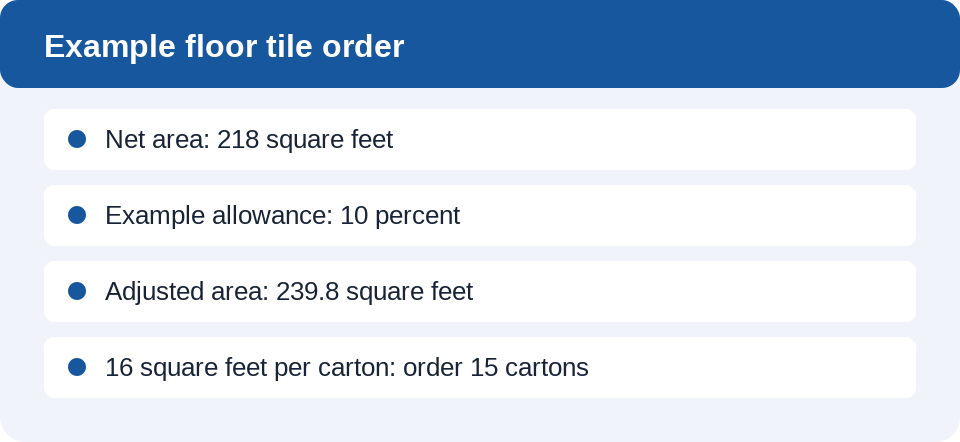
Say a plan shows 218 square feet for one tile type. For this example only, suppose your team selects a 10 percent material allowance after reviewing its layout. The adjusted area is 239.8 square feet. If the supplier confirms that a full carton covers 16 square feet, dividing 239.8 by 16 gives just under fifteen, so round up to fifteen cartons. At that stated coverage the order is 240 square feet. An additional carton requested for retention would be listed separately. Neither the allowance nor the box size in the example should be carried to another project without checking.
What happens if the supplier or layout changes?
Verify coverage from the actual item you will buy rather than from a similar product. Check sold units, package size, availability, and how the estimate handles confirmed selections. If a revised finish schedule changes the tile size or material, review both the allowance and box coverage again. Connect the new quantity to the changed drawing or instruction. The addendum tracking guide describes a simple way to connect the old and new calculations.
Make the purchasing assumptions visible to whoever orders the material. When a location is split across types or colors, the buyer needs each corresponding quantity rather than a single total. Keep installation quantities and order quantities distinct when appropriate. The floor size can be useful for labor, while the carton total is important for materials. If you carry a separate accessory or prep item, identify what quantity or condition determines it.
Review the estimate before it becomes a purchase order
Check whether certain cartons come from a different supplier or finish batch. If the installer needs the same lot across an area, record that requirement and confirm availability before treating the calculated count as ready to order.
Pick one room and ask a reviewer to trace the estimate back to the plan, check the allowance, and reproduce the carton count using the product sheet. Verify the correct rounding direction and confirm any separate stock requested by the owner. Mark unresolved choices so a provisional price isn't treated as a purchase instruction.
Open the Construction Cost Estimator takeoff overview and use the takeoff workspace on one current drawing. Keep the measured area and purchasing math next to each other in your working notes. When the carton size changes or an alternate is accepted, update the relevant line and make sure the finished bid still explains the quantity.